Why recovery matters
Exploring Refrigerant Recovery as the Foundation for Lifecycle Refrigerant Management
The first webinar in COPA's new Building Blocks of Lifecycle Refrigerant Management (LRM) series convened experts and practitioners from across the refrigeration and air-conditioning sector to examine one of the most critical building blocks of lifecycle refrigerant management (LRM): refrigerant recovery. Moderated by Jomari Guillermo (UNDP/COPA Secretariat), the session delved into the practical, operational and policy challenges that continue to limit refrigerant recovery, while highlighting opportunities to strengthen systems in Article 5 countries.
Why recovery matters
Opening the technical sessions, Dr. Sukumar Devotta explained that refrigerant recovery provides the foundation for recycling, reclamation and destruction. Without effective recovery, refrigerants cannot be safely collected, tested, transported or managed further along the lifecycle. Drawing on decades of experience in the refrigeration and air-conditioning sector, Dr. Devotta emphasized that scaling refrigerant recovery will require stronger regulations, better-equipped service technicians, accessible recovery infrastructure and incentives that make recovery economically viable.
Improving refrigerant identification and traceability
In the next session , Martin Botha (A-Thermal) steered the attention to the importance of refrigerant identification, characterization and documentation before refrigerants are transported, reclaimed or destroyed. Using practical examples from refrigerant collection projects in southern Africa, Mr Botha demonstrated why refrigerants should never be identified solely by cylinder labels, as cylinders may contain different refrigerants than indicated or may have been contaminated over time. He stressed that strong documentation and proper classification at the beginning of the process bring dual benefits: it both reduces safety risks and improves downstream refrigerant management.
Barriers to scale
In the last expert contribution, Denise San Valentin, Programme Management Officer with the Climate and Clean Air Coalition at UNEP (CCAC cooling hub) explained why refrigerant recovery continues to remain limited in Article 5 countries. On the other hand, local circumstances in Article 5 countries also offer unique opportunities for LRM business models, especially when a linear perspective is replaced with circular economy thinking. There is money to make with recycled materials and EPR models!
Discussion highlights practical pathways forward
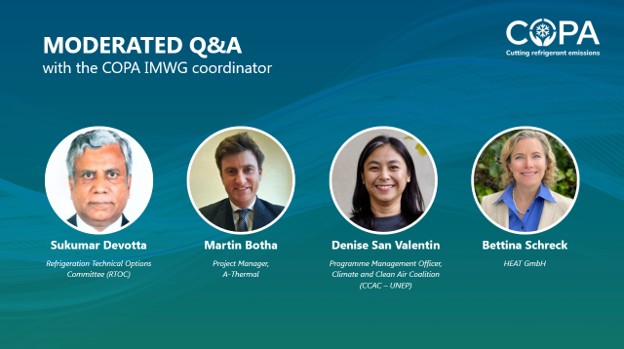
After these insightful presentations, participants got the chance to directly exchange with the experts. The moderated discussion, led by Bettina Schreck, Coordinator of COPA's Implementation Models Working Group. The exchange highlighted several important pre-requisites, including improved recovery and reclamation infrastructure, clearer regulations governing transport and destruction, and greater engagement from equipment manufacturers. Participants also discussed opportunities for regional cooperation and financing to help countries establish more effective lifecycle refrigerant management systems.
Closing the webinar, Malin Emmerich (GIZ) reflected on the importance of grounding lifecycle refrigerant management in practical implementation, noting that the experiences shared throughout the session can help inform future policies and country-level action.
For more details, welcome to download the presentations (pdf) from Dr Devotta, Mr Botha and Ms San Valentin and access the meeting recording (video) here. Also download the Session-article (pdf) for a more detailed summary.
Visit the COPA IMWG website for information on how to join and receive invitations for the next session in in COPA's Knowledge exchange series: “Building Blocks of Lifecycle Refrigerant Management (LRM)”